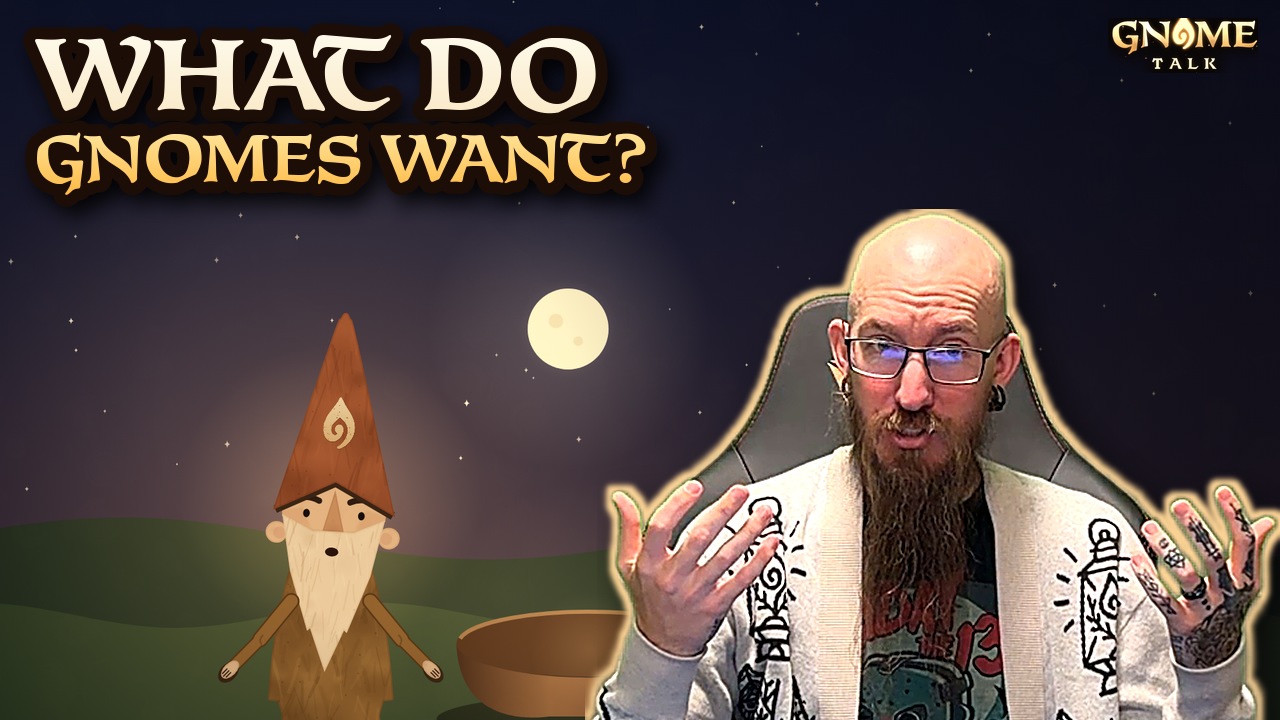
Inside The Gnomean Book of Rituals
Why I wrote the book, how its rites turn belief into practice, and what it offers for weddings, grief, home, and the unseen.
Leaving an offering for the Hidden Ones, sitting beside someone who is grieving, and working out what to say at a wedding may sound like three separate kinds of work. A wooden gnome named Bingus makes it four. They all belong in The Gnomean Book of Rituals because they ask how we give care and attention a form people can actually use.
The book is over five hundred pages. Between the research, writing and rewriting, I put well over five hundred hours into it.
And those pages go far beyond rites and ceremonies. This is the most in-depth exploration we've ever put together of the real philosophy and theology of the Church of Gnome. What we believe, how we understand the sacred, how we approach mystery, and what it means to live by our Principles. The ceremonies grow out of that foundation.
Our son, Cedar Rune Larsen, arrived in July. Becoming a father again while writing about welcoming new life, caring for parents, and honoring the life of a household has given me plenty to think about. Writing about sacred stillness while a newborn baby is crying for a bottle was an interesting challenge but also perfect because that's more like what real life is.
Before we get into any of it, I want to say thank you. To everyone who has stayed with us, shared the Church, asked a thoughtful question, or found something here that made your day better: I am deeply grateful. Knowing this means something to you has been a huge part of what kept me working.
From wisdom to practice
When The Gnomean Book of Proverbs released, it went to number one on Amazon in multiple categories. That was incredible to watch, and I am grateful to everyone who helped make it happen. But what has stayed with me is how deeply the Proverbs connected with people. The book is now finding its way into libraries and other stores, reaching people who may never have heard of the Church. The Book of Rituals carries that work forward. Near the beginning, I explain the relationship this way: "The Gnomean Book of Proverbs gave the Church wisdom in words. This book is about sacred action."
Eventually, an idea meets a moment when we need to use it. You believe in compassion, and someone you love becomes ill. You value gratitude, and another day passes before you stop to notice anything you are grateful for. A friend loses someone, and you wonder what to say when you walk into their house. Ritual gives us ways to meet those moments. We already understand something of this when we sing around a birthday cake, raise a glass, or keep a photograph somewhere important. A gesture can carry what a whole explanation struggles to hold.
The question running through this book is how we give that kind of attention to our lives through the Gnomean Way. There are thirty-three chapters across seven parts. But underneath all those pages is something quite close to home: how we welcome, love, grieve, care, and live alongside a world we will never completely understand.
What makes a rite Gnomean
The foundations matter because a ritual carries the values of the people holding it. Our Principles should be visible in how we treat someone, even before a single blessing is spoken. Individual sovereignty means the person receiving a rite keeps their choice. Compassion means we notice how they are doing. Harmony with nature means the materials and gestures fit the place. Sacred absurdity means sincerity can share a room with a smile.
That last one is particularly important around here. A gnome hat can make someone laugh before they have any idea what we believe. Then the person wearing it might say something about love or grief that reaches them. There is room for both. We don't have to become severe to become sincere. The book also makes room for different understandings of what is happening. Some Gnomeans believe literally in spirits, gnomes, elementals, and the unseen. Others approach the same practices through symbolism, psychology, consciousness, or folklore. Some are still figuring it out.
That uncertainty can be held with care. You can light a lantern beside a photograph and know that the act matters, while remaining unsure how far its meaning reaches. The Sacredness of Maybe gives us room to explore honestly, without pretending to know more than we do. The foundations explain our symbols, the shape of a rite, Gnome Blessings, and the Gnome Hat Bow. They lead into the First Lantern Rite and the Minister's Oath of Service. The point of ministry is to become more capable of caring for others. The hat is excellent. What we do while wearing it matters.
Weddings and the shared path
Weddings deserve some time here, because since the beginning of the Church, people have asked for official Church of Gnome wedding scripts. Often, someone has been asked to officiate for a friend or family member. They care about the couple. They want to do a good job. And they have never stood in front of a room and done anything quite like this before. I wanted the book to give them more than beautiful words to read. I wanted them to understand how to prepare and how to hold the ceremony.
There is a full Gnomean Wedding Rite, an Open Wedding Ceremony for a more familiar shape or a mixed-belief gathering, and a Small Circle Wedding Rite for an intimate ceremony. There is also a Rite of Vows Renewed for a bond with some history behind it. The chapter begins with a teaching I care deeply about: a wedding gives form to love that has already been growing. The couple has already been learning one another, building trust, sharing ordinary days. The ceremony brings that love into vows before witnesses.
And each person remains whole. The book describes them carrying their lanterns side by side. A shared path should leave room for both people to keep becoming themselves. That is something worth thinking about whether you are getting married, officiating, or simply trying to love someone well. A wedding can say something beautiful about devotion. Then the marriage asks what devotion looks like on a tired Tuesday. Bringing a cup of water. Listening after a difficult day. Apologizing while the apology is still small enough to speak easily. Keeping laughter kind. Those are the things a household gnome would be watching very closely.
There is practical guidance for the conversation with the couple, choosing language and readings, rehearsal, timing, rings, family participation, and including Sacred Companions. There is guidance on checking the requirements where the wedding takes place and understanding who handles the documents. I wanted a first-time officiant to have a real starting point. One of the most useful lessons is remembering whose moment it is. The officiant holds the ceremony steady so the couple can be present inside it. A personal story should help people understand the couple. A joke should belong in the room. If someone struggles to get through a vow because they are crying, give them time.
You don't have to fill every silence. Sometimes patience is the most helpful thing you bring. And on the new website, there are in-depth guides to officiating a wedding and shaping your own unique wedding script. I wanted the book and the website to support someone from that first nervous "I've been asked to do this" through preparing a ceremony that actually feels like the couple.
Welcoming life and staying beside grief
The life passages include welcoming children, chosen names, chosen family, reconciliation, illness, recovery, death, and grief. The care looks different in each moment. Welcoming a child has been especially close to me this year. In the Young Gnome Blessing, the adults make the promises. The child remains free to grow into their own beliefs, identity, and direction. Think about what that asks of the grown-ups. We are promising care before we know who this person will become. We offer a home, stories, values, and protection, while remembering that their life belongs to them. With Cedar here, that has felt very immediate.
There are blessings for parents and recovery after birth too. The person keeping everyone fed, comforted, and held needs care themselves. A blessing should draw our attention toward that person, and toward what we can actually do for them when the words are finished. That same responsibility carries into illness and grief. At a bedside, the person who is unwell gets to decide what they can receive. A long reading may be too much. Quiet company may be enough. The ritual should fit their strength and wishes.
With grief, we can feel a terrible pressure to say something that makes it better. Sometimes that pressure makes us say more than the person needs. We explain, reassure, or reach for a meaning they haven't asked us to give. The grief chapters make room for remembrance, silence, and different beliefs about death. A name can be spoken with care. A lantern can give everyone a place to gather their attention. A familiar story can let the person who died be remembered as themselves.
And grief can return long after the public ceremony is over. Being there later matters too. The message, the meal, the remembered anniversary, the willingness to hear the same story again. There is a kind of ministry in remembering when the rest of the world has gone back to its schedule.
Sacred Companions and the ordinary day
Of course, Sacred Companions have a substantial place in this book. Around here, a dog is one of the co-leaders of the Church. Phantom, our Grand Paw, has made a fairly strong case for the ministry of presence. Animals often know how to stay beside us without trying to explain everything. Their companionship can be woven into our days so thoroughly that we only realize its full shape when something changes.
The book honors their welcome, ordination, daily care, aging, and loss. Their participation follows their comfort. A pet at a wedding may be a beloved witness, but the pet is still a living being with needs. If they decide they have contributed enough to the ceremony, someone should help them retire from public service. That care for ordinary needs runs through the daily practices too. There are rites for the first cup of the day, leaving home, returning, sharing food, beginning work, making a mistake, and resting.
The First Cup starts with the words, "First cup, wake me kindly." I love the gentleness of that. Before the day gets hold of us, we acknowledge the body that has to live it. We give thanks while we are still holding something warm. Coming home asks something different. Have you ever arrived home physically while your mind was still arguing with something that happened hours earlier? A threshold can become a place to notice that. Set down the keys. Let the day settle a little before you bring its whole weight into the room.
These are small acts, but repetition gives them depth. The cup was already there. The doorway was already there. We begin giving attention to something we used to pass through automatically. And yes, there is a practice called The Chair of No Further Nonsense. One of its lines is: "My mind is not required to attend every argument it invents." That is a useful sentence to keep around. There are times when the next wise action is to sit down and allow an imaginary argument to continue without your attendance.
Home and the Hidden Ones
The household chapters explore thresholds, household gnomes, gifts, and the Hidden Ones Offering. They ask us to think about home as a place of relationship. Older traditions have many names for helpers and presences of household and land. The book explores some of that history while respecting that those names come from different traditions. They aren't all interchangeable. There is a history behind a tomte, a brownie, or a domovoi, and learning that history matters.
The Hidden Ones Offering gives a household a way to offer thanks with humility. It might be a small bowl of water, a flower, or another fitting gesture. For someone who believes in household spirits, it may be a literal act of hospitality. For another person, it may honor ancestry, unseen labor, or all the care that makes a home possible. Consider how much we depend on that we rarely see. Someone built the house. Someone grew the food. Someone keeps things repaired. Soil, weather, plants, animals, and countless human hands participate in our ability to have an ordinary morning.
An offering can remind us to give thanks before asking for more. And that attention should reach the people sharing the home. We can become remarkably good at noticing a mess while becoming almost blind to the work that quietly prevented ten other messes. Notice what helped. Thank the person. Do some of the work yourself. That is a household practice with real consequences. The book also treats hospitality as something held with boundaries. We can welcome what is kind and peaceful without surrendering the home. Generosity and good judgment belong together. And any offering should fit the place, so our gesture of care remains care when it reaches the land.
Mystery and the turning year
The book also spends real time with the unseen. There are chapters on discernment, elemental practice, gardens and wild places, the Contact Compass, the Bindrune, Sasquatch, and sky contact. Those subjects belong here because openness to mystery has always been part of the Gnomean path. Some people will meet these chapters with literal spiritual beliefs. Others will meet them with curiosity, symbolism, or a love of folklore. The book gives them room to approach honestly. The Contact Compass has four points: Place, Posture, Participation, and the Unseen.
Place asks where you are meeting the world and how you attend to it. Posture asks how you arrive. Are you rushing, demanding, or willing to be a guest? Participation asks what you bring through a greeting, an act of care, or a fitting gesture. The Unseen leaves room for what you cannot control, including silence. That last part matters. An invitation can remain unanswered. We can have an experience without immediately knowing what it was. We can take it seriously enough to reflect on it while leaving the explanation open.
Imagine returning to the same garden corner for a while. You slow down. You learn what grows there. You notice birds, weather, insects, and the way the light changes. You tend something. You keep a record of what you experience. For some, a spiritual relationship may deepen there. For others, a relationship with place becomes more attentive and alive. Neither needs to manufacture an extraordinary story to make the time worthwhile. The seasonal rites give that attention a shared rhythm: Renewal at the spring equinox, Radiance at the summer solstice, Harvest at the autumn equinox, and Vigil at the winter solstice.
They use things we can actually hold and do. Seeds enter soil. Food is shared. Something is gathered, something released, a light carried through darkness. The year becomes something we participate in. But the book is careful about how far we push the comparison between seasons and our own lives. Grief may arrive in spring. Joy may return in winter. You can be harvesting one part of your life while another part is barely beginning to grow. The seasons give us a rhythm to consider. They leave room for the life we are actually living. A person keeping Vigil alone with a little lantern can belong to that rhythm alongside a whole circle gathered outdoors.
The work behind the pages
That is some of what those five hundred pages hold. I wanted the book to have enough depth to explore, and enough practical guidance to use when the moment arrives. The work involved researching older traditions, writing the theology and philosophy, shaping the rites, and then going back through them to ask how they would sound and work in a real room. What needs to be prepared? Who speaks? Where might someone need a pause? How can the rite adapt when a person is tired, a family holds different beliefs, or the materials are simple? Those questions led to a lot of rewriting.
My wife and our children have given me an enormous amount of patience through it all. I am very grateful to them. And I am grateful to this community. Your questions, your humor, and the lives you have shared with us helped me understand what this book needed to be. You can read it through, then return to the chapter you need. There are finders in the back to help locate a practice by the situation you are facing. I hope it becomes a book people actually use, with pencil marks, coffee rings, garden dirt, and signs that it has been somewhere with them.
Building a new home for the Church
The website grew alongside the book. I was building it simultaneously because the book inspired basically every single feature. As the writing developed, I kept asking how the website could help people explore these teachings and carry them into daily life. I knew the old website was clunky. It helped us get started, but it wasn't the experience I wanted people to have. So I worked tirelessly to design and build a place you could spend hours exploring and get real personal value from, with reasons to come back every day.
The public side has daily Proverbs, reflections, and practices. The Almanac and Observatory connect with the changing sky and seasons. The Oracle, guided Paths, and Quest Board offer ways to reflect and participate. There are currently two hundred and forty quests, including learning to identify a tree, plant, or bird near your home, tending a small patch of ground, and making room for sacred absurdity.
In the member area, the Lantern Journal gives you a private place to write. Saved Wisdom and your Ritual Shelf keep what you want to return to. Shape a Rite helps you develop a personal practice. There is a Field Guide, a Contact Compass, tools for preparing ceremonies, and a place for your Sacred Companions' stories and memories. Lantern Study explores all thirty-three chapters through questions and reflection. And there are those in-depth wedding guides, whether you're preparing to officiate for the first time or creating a unique script for a particular couple.
You might read a proverb, spend a little time outside, and record what you noticed when you return. Tomorrow offers another reflection, a changed sky, and something new from your own experience. Five minutes can be useful. You can also stay and explore. The Commons gives us a much better place to share that experience. You can find conversations, follow your interests, ask questions, and get to know people.
For local connections, there is a dedicated space, filters by country, region, and city, and optional location tags on posts. You choose how much detail to include. That makes it easier to ask who is nearby, find a conversation in your area, or suggest a walk or gathering. I would love to see those conversations become friendships and local circles. I have also always had the goal of making a Church of Gnome app. I built this website with that in mind, so there is now a clearer path forward toward making it happen. That is something I am excited to keep working toward.
When you visit, introduce yourself in the Commons. A website can give us the space. The community brings it to life.
Art and the things we carry
Alongside all of this, I worked with a couple of amazing artists on new merchandise and new ordainment certificate designs. I am grateful for the talent and care they brought to it. Our ordainment cards have had a major upgrade too. They are now high-quality PVC cards, replacing the laminated paper ones. It feels good to offer something more durable that people can carry with them.