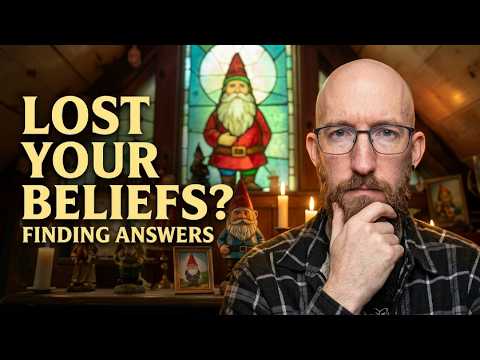
Leaving Religion Without Giving Up the Sacred
What can remain after you leave a belief system, and how to be curious again without committing to another set of answers.
Leaving a religion can feel like losing more than an answer about God. You might lose your weekly routine, the people you call when things go wrong, or the language you reach for when you're scared. Some people feel relieved the day they leave and guilty the day after. Both feelings can show up before you've even worked out what you want to call yourself.
Why People Leave
Let’s begin where this journey often begins – not with answers, but with something breaking open. People don’t usually walk away from religion casually. It’s not something most do on a whim. It often comes slowly. Painfully. Quietly. And sometimes with more grief than they expected. For some, the decision happens in a moment – an undeniable moment of harm, hypocrisy, or heartbreak. For others, it happens over years… like an unraveling sweater. One thread at a time.
You start to feel a tension you can’t name. A dissonance between what you were told to believe and what you feel in your body. You sit in a room full of people saying the right things, and you suddenly realize… you’re not there anymore. And maybe you can’t even explain it to the people around you. Because it’s not just one thing. It’s a thousand little things. You start to notice the language that’s rooted in fear. The unspoken rules about who is acceptable.
The guilt that keeps you showing up even when your soul is dry. Or maybe it’s even simpler than that: You just… outgrew it. And that’s not failure. That’s life. Some people leave because they’re told they have to choose between being who they are and being loved by God. Some leave because their questions were never welcomed – only silenced. Some leave because what once felt like home now feels like a room they’re no longer allowed to breathe in.
And some stay for years, even when it hurts – because leaving feels like losing their history, their family, their entire identity. So if you’ve left, or are thinking of leaving, I want you to hear this clearly: You are not betraying something sacred by walking away from something that no longer is. You’re not lost – you’re listening. You’re not rejecting the sacred – you’re refusing to settle for a version of it that caused you harm. And maybe no one said this to you when you stepped away, so I will: It takes immense courage to walk away from a belief system that shaped you.
To leave a church, a doctrine, a story, or a community – not because you’re angry, but because you’re honest. And it’s okay to grieve what you left. Even if you had to leave it. Even if you’re sure it was the right choice. It’s okay to miss the music. The rhythm of ritual. The sense of certainty.
The people you used to feel close to. You can love what it once gave you… and still know that you can’t go back. Leaving doesn’t mean you’ve stopped caring. Sometimes it means you care too much to stay where love became conditional. Where truth was weaponized. Where your identity or your questions were too much for the walls that held you. You are not alone in this.
And your leaving? That’s not the end. It might just be the beginning of something more true.
What Gets Lost – and What Can Be Kept
One of the hardest parts of leaving a spiritual path isn’t just the leaving itself. It’s what you lose along the way. And not all of it is bad. Some of it needed to go. The fear. The shame. The pressure to make holiness a performance.
The quiet knowing that if you questioned too much, or loved the wrong person, or didn’t conform… there would be consequences. Those things? Yes, they can go. Those are not sacred. Those are not love. But then there’s everything else. The parts you maybe didn’t want to lose. The songs.
The rituals. The comfort of having language for mystery. The way prayer gave you a place to rest. The feeling of being held by something bigger than yourself – even if that “something” feels distant now. When you walk away from religion, it can feel like you’re walking away from the sacred itself. Like it was all tied together in one fragile bundle – and if you let go of one thread, the whole thing unravels. But I dont believe that The sacred belongs to any one religion.
The sacred is locked inside a building, or a doctrine, or a hierarchy. I do believe that The sacred is still yours. You can leave the dogma and keep the wonder. You can let go of the fear and still light a candle when you need something to pray to. You can reclaim silence. Reclaim breath. Reclaim ritual on your own terms. You don’t have to throw everything away just because the system failed you.
It can be healthy to reflect on: What did you lose that you didn’t want to lose? What part of your old tradition actually brought you peace, or meaning, or beauty – before it got tangled up in fear? What could it look like to carry that forward in a way that honors you, now? You’re allowed to keep the good. To reimagine it. To soften it.
To set it down and pick it up again in a new form. You’re allowed to light incense – not because someone told you to, but because your spirit finds rest in the smoke. You’re allowed to bless your meals – not out of obligation, but out of quiet gratitude. You’re allowed to talk to the sky. To believe in something. Or to not know what you believe… and still feel something stir in your chest when the light hits the trees just right. The sacred is not gone.
It’s just waiting to be met in a new way. And here’s the beauty: You get to decide what you keep.
Making Peace with Ambiguity
One of the strangest parts of leaving a belief system – especially one that gave you clear answers – is what comes next. The silence. The not-knowing. That place in between: Not where you were… but not quite sure where you’re going either. It can feel like being spiritually untethered. Like you’ve stepped off the path and now you’re just wandering.
You might miss the clarity. The structure. The way things used to make sense – even if they came with fear or pressure. And now? You’re asking new questions. Or maybe you’re tired of asking anything at all. This space – the in-between – is tender. It’s frustrating.
But it’s also deeply sacred. Because here’s what many religions don’t prepare us for: Ambiguity is holy. Not everything that’s uncertain is broken. Not every mystery needs to be solved. Not every spiritual path needs a map. Sometimes, faith looks like sitting in the middle of not-knowing… and choosing to stay open.
There’s a quiet strength in that. A deeper kind of reverence. Not the kind built on answers – but on presence. You don’t need to rebuild your beliefs overnight. You don’t need to find a new label. You don’t need to figure out whether you’re spiritual, religious, mystical, agnostic, all of the above or none of the above. You just have to stay honest.
To stay present. To pay attention to what still feels real – what moves you, what quiets you, what awakens something deep inside you. There’s wisdom in the wandering. There’s holiness in the pause. There’s clarity that grows like moss – soft, slow, and hidden at first. So if you feel like you’re floating right now – not fully grounded in any belief, unsure of what’s next – I want to remind you: You haven’t lost your way.
You’ve just outgrown the one you were told was the only way. And the sacred? It’s not waiting at the destination. It’s walking beside you already.
A Different Kind of Sacred – The Gnomean Way
So if you’ve left the path… If you’re sitting in the ambiguity… If you’re still carrying a quiet hunger for meaning but no longer want the map you were handed – You might be wondering: Is there anything left that’s still sacred? And the answer is… yes. But maybe it looks different now.
Maybe the sacred doesn’t come wrapped in certainty. Maybe it doesn’t come from a pulpit or a book or a lineage. Maybe it comes from soil. From silence. From your own breath. Maybe it comes from something strange. Something small. Something like… a gnome. Now, I know on the surface, gnomes might not seem like the most obvious symbol for spiritual life. But stay with me.
Gnomes, in folklore, are quiet beings. Earth-connected. Humble. They’re not worshipped. They don’t demand rituals. They don’t speak in commands or require perfection. They tend. They care. They observe. They protect. They belong.
And that, to me, is what sacredness looks like now. Not a list of rules. Not something you have to perform or earn. But a way of being in the world that’s grounded, honest, and connected. The Church of Gnome was never meant to be a replacement religion. It was never about telling you what to believe. It was about creating a space where people could gather without pressure – A spiritual garden, not a gated system.
A space for laughter and grief. For skepticism and wonder. For presence without performance. For questions that don’t need to be resolved, only respected. Maybe the sacred now is letting yourself not know, and being okay with that. Maybe it’s sitting with a friend and naming what hurts – without trying to explain it away. Maybe it’s watching the wind move through the trees and knowing – even if you don’t understand it – that something in you softens when you do.
That’s the kind of sacred we’re practicing here. And you’re welcome to step into it – no test, no theology quiz, no gatekeeping. Just you. As you are. Bringing whatever you still carry from the path you left behind. And whatever you're just beginning to grow. You don’t need to believe in gnomes to walk the Gnomean path.
But if you believe in stillness, in kindness, in curiosity, in showing up to life with both reverence and humor – You’re already walking it.
What stays with us
If you’ve made it this far into the episode, I want to say something very simple, and very true: I see you. I see the way you’ve carried questions that didn’t have safe places to be asked. I see the way you’ve mourned things that others told you not to grieve. I see how hard it is to walk away from a belief system – not just because of what it taught you, but because of how deeply it shaped your world. Maybe you miss the rituals. The music.
The language for the things you can’t quite explain. Or maybe… you don’t miss any of it. But there’s still a part of you that quietly aches for connection. For awe. For something real. And I want you to know: You don’t have to go back.
You don’t have to rebuild exactly what you left. And you don’t have to stay in the in-between forever. But you also don’t have to rush. The sacred hasn’t gone anywhere. It’s just not confined to the old forms. It’s in your breath. It’s in your questions.
It’s in the way you notice things other people overlook. It’s in the act of leaving, and in the act of listening. And if you’re not sure what you believe anymore – Or if you believe anything at all – That’s okay. This isn’t about belief. This is about presence.
You don’t have to go back. And you don’t have to walk alone. There is still room for you. There is still space. And wherever you are now –